
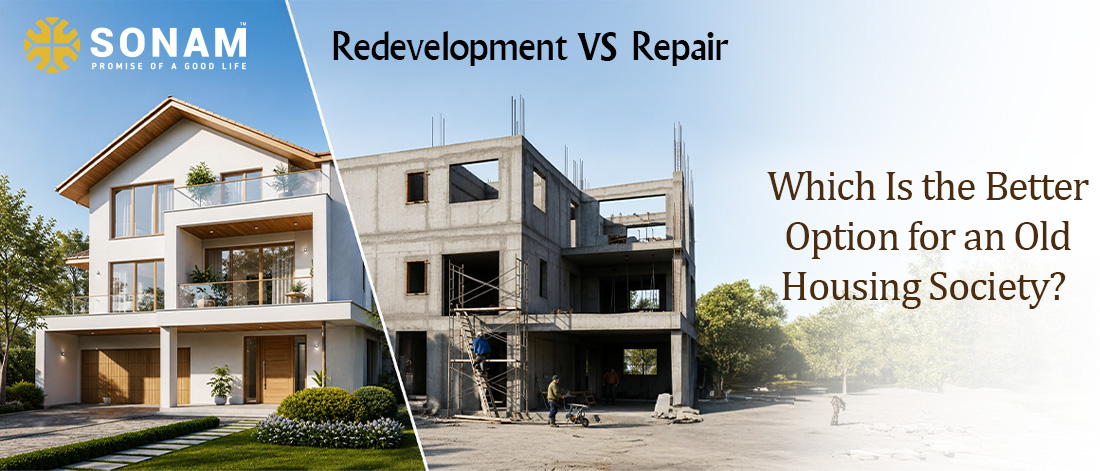
Quick Answer
For aging housing societies, the decision between redevelopment and repair depends on the building’s structural condition, maintenance costs, redevelopment potential, regulatory approvals, and the long-term goals of residents. Repairs can address localized issues and extend the life of a building for a limited period, while redevelopment replaces the existing structure with a modern building that meets current construction standards, offers improved amenities, and may enhance long-term property value. A structural audit and professional technical assessment should guide the final decision.
Introduction
Across Mumbai and the Mumbai Metropolitan Region (MMR), many residential buildings constructed decades ago are reaching an age where housing societies face an important question: Should we continue repairing the building or consider redevelopment?
This decision goes beyond comparing construction costs. It affects resident safety, maintenance expenses, future property value, living standards, and the long-term sustainability of the housing society.
While repairs may appear to be the quicker and less disruptive solution, they are not always the most effective option for buildings with significant structural deterioration or outdated infrastructure. Redevelopment, on the other hand, offers an opportunity to create a modern residential community but requires careful planning, regulatory compliance, and cooperation among society members.
Understanding the advantages and limitations of both options allows societies to make informed decisions based on their building’s condition and future requirements.
What Is Building Repair?
Building repair refers to maintenance work undertaken to restore or improve specific parts of an existing structure without replacing the entire building.
Typical repair work may include:
- Waterproofing
- Structural strengthening
- External plaster repairs
- Painting
- Plumbing replacement
- Electrical upgrades
- Terrace repairs
- Lift modernization
Repairs are generally suitable when the building remains structurally sound and the identified issues can be addressed without major reconstruction.
Regular maintenance plays an important role in preserving building safety and extending the usable life of residential properties.
What Is Redevelopment?
Redevelopment involves demolishing an existing building and constructing a new residential project on the same land, subject to applicable approvals and development regulations.
Unlike repairs, redevelopment provides an opportunity to redesign the entire property according to modern engineering practices, updated building codes, and contemporary lifestyle expectations.
Redeveloped projects often include:
- Improved structural safety
- Modern amenities
- Better space planning
- Enhanced fire safety systems
- New elevators
- Improved parking arrangements
- Efficient utility infrastructure
- Contemporary architectural design
For many aging housing societies, redevelopment represents a long-term investment in safety, comfort, and future property value.
When Is Repair the Better Option?
Repair may be the more practical solution when the building’s structural framework remains stable and only specific components require attention.
Housing societies may consider repairs when:
- Structural audits indicate the building is safe.
- Maintenance issues are localized rather than widespread.
- The building has relatively low redevelopment potential.
- Residents prefer minimal disruption.
- Major systems can be upgraded without reconstruction.
Periodic repairs help maintain residential buildings and prevent smaller issues from becoming larger structural concerns.
However, societies should understand that repairs generally extend the building’s lifespan rather than eliminate long-term aging-related challenges.
When Does Redevelopment Become the Better Choice?
Redevelopment becomes a stronger option when repeated repairs no longer provide lasting solutions or when the building has reached the end of its practical service life.
Indicators that redevelopment may be worth evaluating include:
- Frequent structural repairs
- Rising maintenance expenses
- Aging infrastructure
- Inadequate parking
- Outdated layouts
- Safety concerns identified during structural audits
- Increasing resident expectations for modern amenities
In such situations, redevelopment offers an opportunity to replace aging infrastructure rather than continually repairing it.
A professional structural audit remains the most reliable method for determining whether redevelopment should be considered.
Redevelopment vs Repair: Key Factors to Compare
When evaluating redevelopment and repair, housing societies should consider the decision from both short-term and long-term perspectives.
Repairs typically require lower initial investment and less disruption. They can effectively resolve maintenance issues where the building remains fundamentally sound. However, repeated repairs over many years may result in increasing maintenance costs without addressing aging infrastructure.
Redevelopment involves a more extensive process, including society approvals, developer selection, statutory permissions, temporary relocation, and construction. While this requires greater planning and coordination, it can provide long-term improvements in safety, comfort, building efficiency, and overall quality of life.
The most appropriate option depends on the building’s condition, redevelopment feasibility, financial considerations, and the objectives of society members.
How Redevelopment Can Improve Long-Term Property Value
One of the significant advantages of redevelopment is its potential to enhance the long-term appeal of a residential property.
Modern buildings generally offer:
- Updated engineering standards
- Better amenities
- Improved layouts
- Enhanced common areas
- Energy-efficient systems
- Contemporary architecture
These improvements can increase buyer interest and strengthen the property’s market perception over time.
Although market performance depends on several factors, well-executed redevelopment projects often create more attractive living environments compared to aging buildings requiring frequent repairs.
The Importance of a Structural Audit
Before deciding between repair and redevelopment, housing societies should obtain an independent structural audit from qualified professionals.
A structural audit evaluates:
- Overall building stability
- Structural deterioration
- Repair feasibility
- Safety concerns
- Expected remaining service life
The audit provides objective technical information that helps societies make informed decisions rather than relying solely on visible signs of aging.
Professional engineering advice is particularly important for older buildings where structural issues may not always be immediately apparent.
Choosing the Right Redevelopment Partner
If redevelopment is determined to be the preferred option, selecting the right developer becomes one of the most important decisions for the housing society.
Societies should evaluate developers based on:
- Redevelopment experience
- Construction quality
- Financial capability
- Regulatory compliance
- Track record
- Customer reputation
- Communication practices
For societies in Mira Road and the Mumbai Metropolitan Region, Sonam Group has built a strong presence through its residential developments and redevelopment initiatives. With a focus on quality construction, thoughtful planning, customer-centric execution, and compliance with applicable regulatory requirements, Sonam Group works closely with housing societies to deliver redevelopment projects that meet modern living standards while respecting the interests of existing residents.
Before appointing any developer, societies should review completed projects, evaluate redevelopment experience, and seek independent legal and technical advice.
Making the Right Decision for Your Housing Society
There is no universal answer to whether repair or redevelopment is the better option.
Each society has unique structural conditions, financial considerations, redevelopment potential, and resident expectations.
The best approach combines professional structural assessment, financial evaluation, legal guidance, and transparent communication among society members.
When decisions are supported by expert advice and long-term planning, societies are better positioned to choose the solution that delivers lasting value and improved quality of life.
Conclusion
Choosing between redevelopment and repair is one of the most significant decisions an old housing society will make. While repairs can extend the life of a structurally sound building and address immediate maintenance concerns, they may not resolve the limitations of aging infrastructure or meet evolving lifestyle expectations. Redevelopment offers an opportunity to create a safer, modern, and future-ready residential community, provided it is supported by careful planning, regulatory compliance, and the right development partner. By relying on structural audits, expert guidance, and transparent decision-making, housing societies can select the option that best serves the long-term interests of their residents.
FAQs
Q1. What is the difference between redevelopment and repair?
Repair addresses specific maintenance or structural issues in an existing building, while redevelopment replaces the old building with a newly constructed residential project.
Q2. How do I know if my housing society needs redevelopment?
A professional structural audit can determine whether the building remains suitable for repairs or whether redevelopment should be considered based on its condition and expected service life.
Q3. Is redevelopment better than repeated repairs?
For buildings with significant structural deterioration or aging infrastructure, redevelopment may provide a more sustainable long-term solution. The appropriate option depends on technical assessments and society requirements.
Q4. What are the benefits of redeveloping an old housing society?
Redevelopment can provide improved structural safety, modern amenities, better layouts, enhanced infrastructure, updated building systems, and stronger long-term market appeal.
Q5. Why should housing societies consider Sonam Group for redevelopment?
Sonam Group has experience in residential development and redevelopment within the Mumbai Metropolitan Region, with a focus on quality construction, regulatory compliance, and customer-centric project execution.